Custom Shirts, DesignFebruary 28, 2018
Printed Shirt Tags
What a printed neck tag is, where it goes, what it has to say, and five design tips from our press
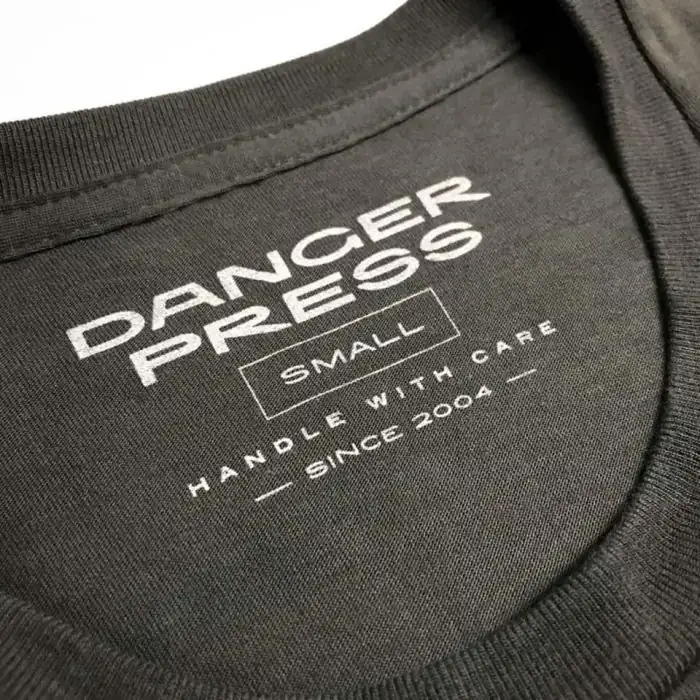
A printed tag is your brand’s label screen printed straight onto the inside of the shirt, in place of the sewn-in label the blank came with. We remove the factory tag and print yours in the same spot, inside the back of the neck. Most of our tags are 3 inches wide, and printing one costs $1 a shirt on orders of 50 or more, or $2.50 a shirt under 50, plus $10 per size for screens.
Printed custom tags are a great branding opportunity to give a finished look to your product. They make a t-shirt more comfortable to wear and provide the consumer a connection with your brand, every time they wear your design.
As we've been doing this for a while, we'd like to offer the following suggestions and cost-saving tips when creating your own.
What Is a Printed Shirt Tag?
A printed tag, also called a tagless label or neck print, replaces the fabric label sewn into the collar. It usually carries your name or logo and the shirt’s size, and it can carry the information the law asks for on clothing you sell (see below).
Brands choose printed tags for three reasons. There’s no stiff label edge to scratch the back of the neck. A blank shirt becomes your product, with your name where the manufacturer’s used to be. And because there’s a different tag for each size, the size is printed right on it.
Most of the tags we print are one color. White, Pantone 430 C gray and black are the most common.
Where Does a Printed Tag Go, and How Big Is It?
Where the factory tag was. We remove the blank’s label, then print your tag in that spot: centered inside the back of the neck, just below the collar. That’s also where U.S. labeling rules put the country of origin on a shirt with a neck, so one print can do both jobs.
Size: most of the tags we print are 3 inches wide. The height follows your artwork, often about 1.75 to 2.5 inches. The largest area we print inside the neck is 3.5 inches wide by 3 inches tall. Smaller tags of 2 to 2.5 inches wide are common for simple marks.
Other spots: a hem tag is a small print on the outside of the shirt near the bottom hem. A nape print sits on the outside, just below the back collar. Both are covered in tip 5, below.
Do You Remove the Factory Tags?
Yes, every kind: tear-away labels, cut-away labels, and labels sewn all the way into the collar seam. They come out before your tag goes on, so the finished shirt carries only your label. Tag removal is $0.75 a shirt.
If you’d rather start from a blank that has no label at all, many brands make tear-away or tagless versions of their shirts. Ask us when you order, and we’ll tell you which of your shirt choices come that way.
What Has to Be on a Clothing Tag?
If you sell your shirts, some of it is required by law. Under the Federal Trade Commission’s (FTC) textile labeling rules, clothing sold in the U.S. needs:
- Fiber content, by generic name and percentage, such as “50% polyester, 25% cotton, 25% rayon.”
- Country of origin, where the blank was made. On a shirt with a neck it goes inside the center of the neck, where the printed tag sits.
- Your company name or RN. An RN (registered identification number) is a free number the FTC issues to U.S. businesses that make or sell textile products.
- Care instructions, under the FTC’s Care Labeling Rule. They may be printed right on the shirt, as long as they stay readable for its whole life. Words or the standard care symbols both count.
When you replace a blank’s label with your own, the FTC requires the new label to carry the same required information as the one removed, under your name or RN. Keep a record of what the original label said, and who you bought the shirts from, for three years.
Printing in the U.S. doesn’t make an imported blank “Made in USA.” The label names the country where the shirt was made, and it can also name the work done here, in the FTC’s own pattern: “Made in Honduras, finished in USA.”
This is general guidance, not legal advice. The FTC’s guides Threading Your Way Through the Labeling Requirements and Clothes Captioning have the details, and RNs are free to request from the FTC.
Five Tips for Designing a Printed Tag
1. Eliminate borders
Not to say it can't be done, but there's more room for error when we print a tag with a circle or rectangle around your text. We use a thin glue on our printing surface to hold the shirt in place as it's being printed. When we remove the shirt from the board, the design can warp, causing a circle to appear more oval, or for an edge to appear slightly higher on a rectangle. Wander North Georgia’s tags are a perfect example of how to create a circle without an outline.
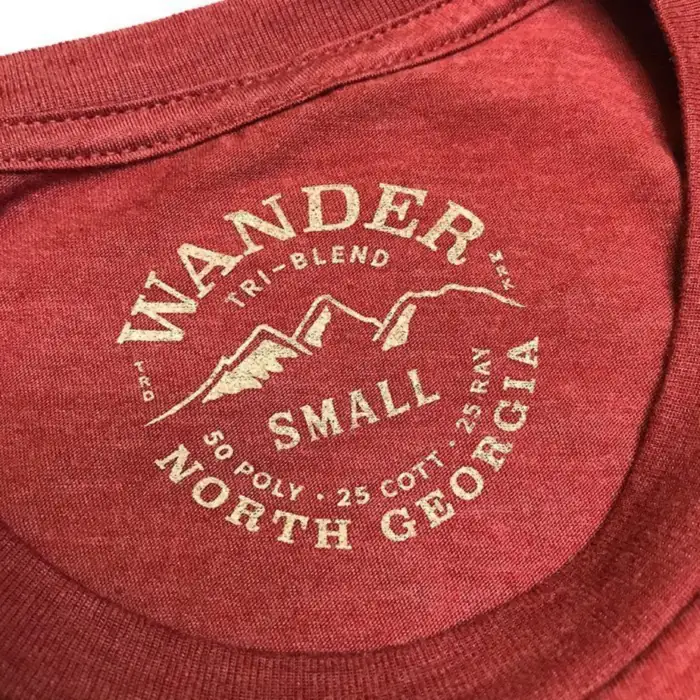
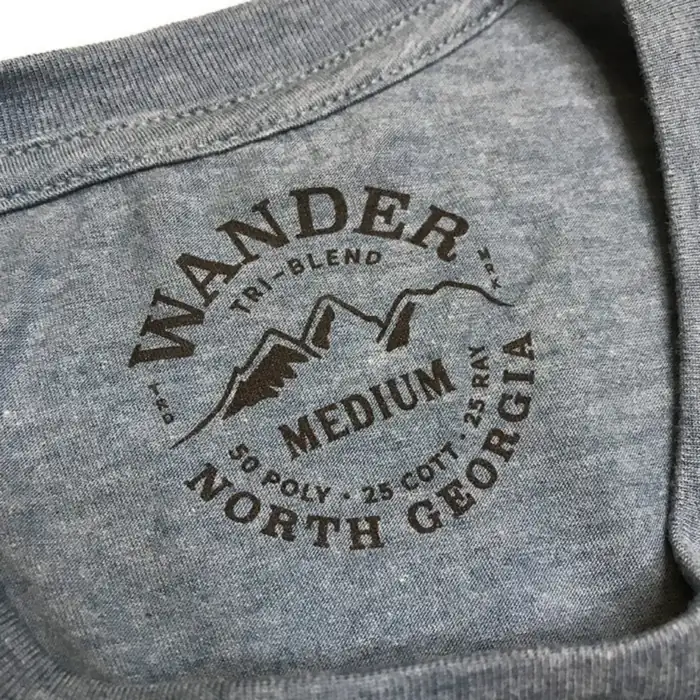
2. Content is key
We recommend including your brand name or logo, the t-shirt size, the garment's country of origin, and fabric content. Or don’t. It’s your tag and it should speak true of your brand. So Worth Loving's neck tags include their mission statement. In contrast, Post Post Works keeps their tag simple.
Selling the shirts? Some of this is required. See what has to be on a clothing tag, above.
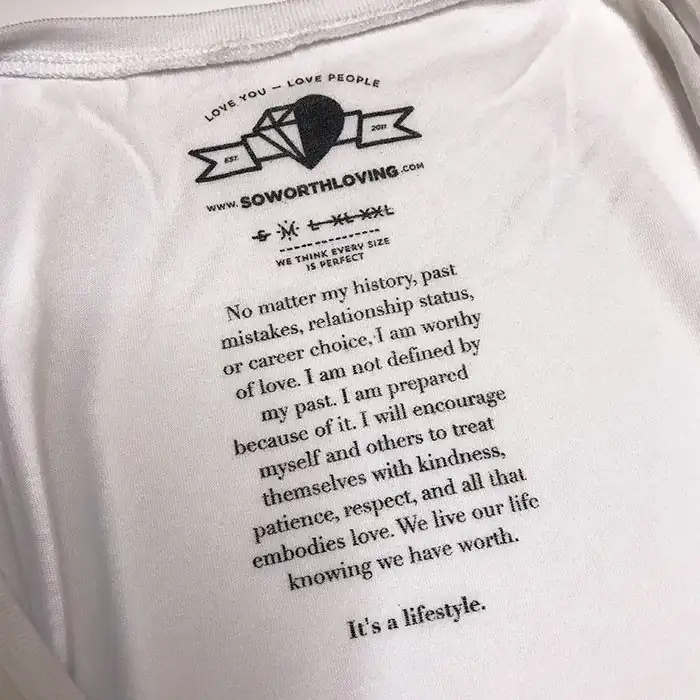
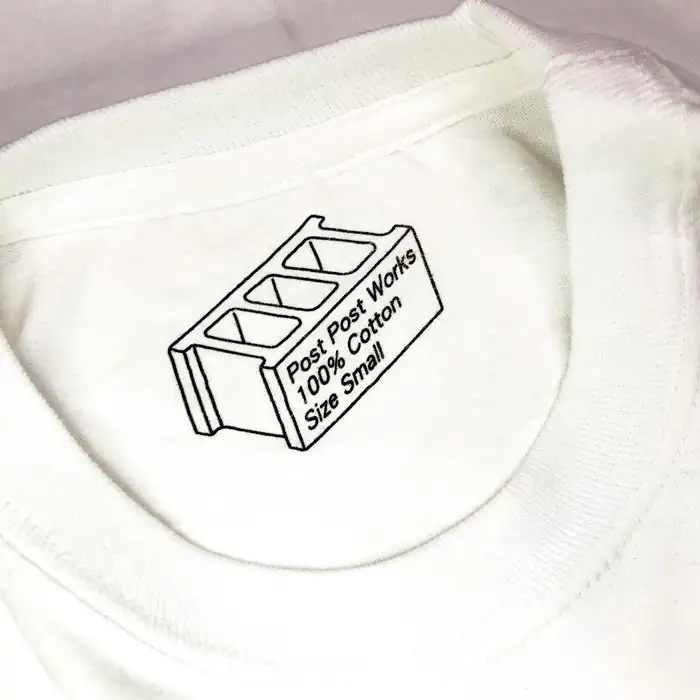
3. Things could get muddy
Since ink likes to spread as it's placed on fabric, tiny text, trademarks, and archaic laundry symbols (who knows what those mean, anyway?) can become blurry-looking. We always try to account for this behavior before we go to press, but oftentimes it's easier to leave these details out.
Care instructions are required on shirts you sell. A few short words, such as “Machine wash cold, tumble dry low,” stay readable where tiny symbols blur.
4. Go grey
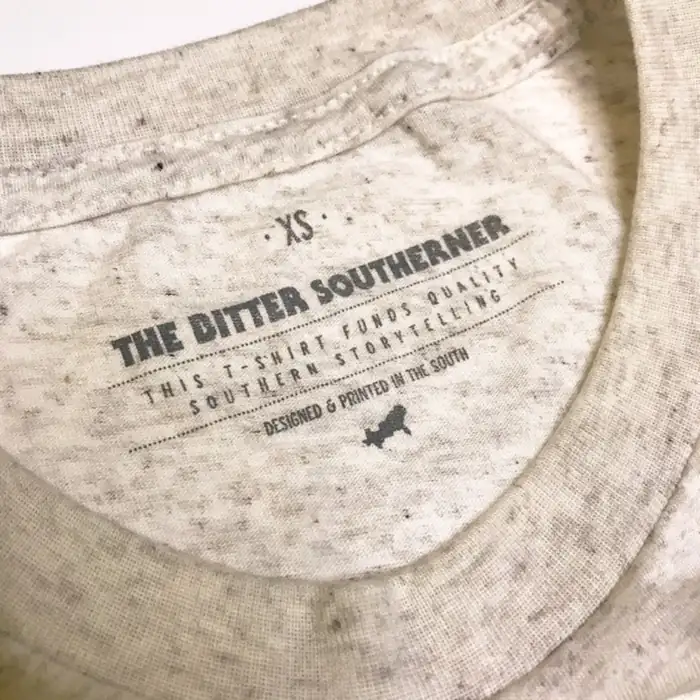
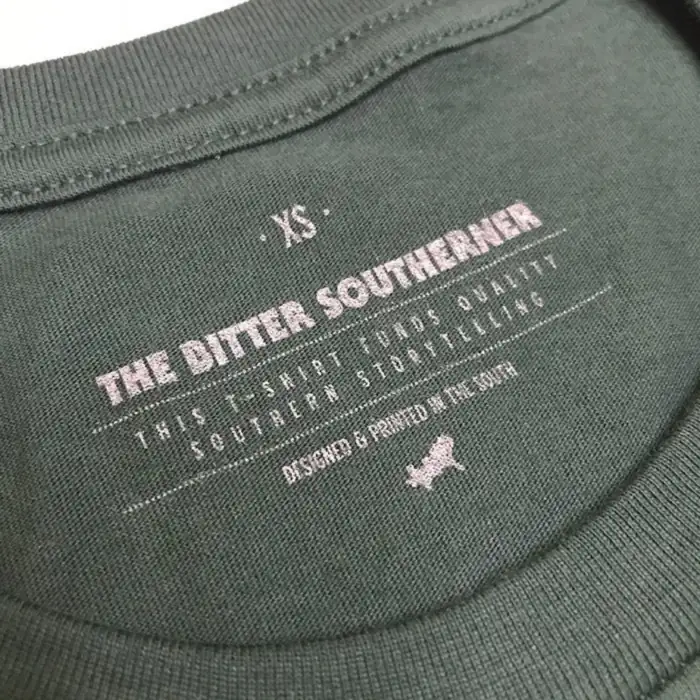
Generally, our clients like to match the tag to a color on the front print. If you’re printing the same design on multiple shirt colors, it’s likely you’ll want to change the print color as well. An additional cost arises when we change the ink from one shirt color to the next. If you want to avoid this cost, we’ve found that 430 C Gray proves visible across multiple shirt colors, like The Bitter Southerner's tags, pictured below.
5. Put your logo elsewhere
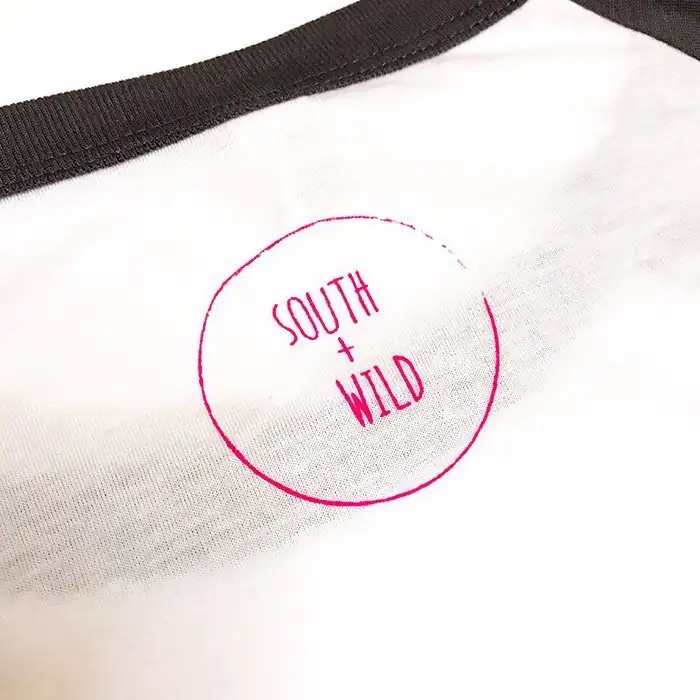
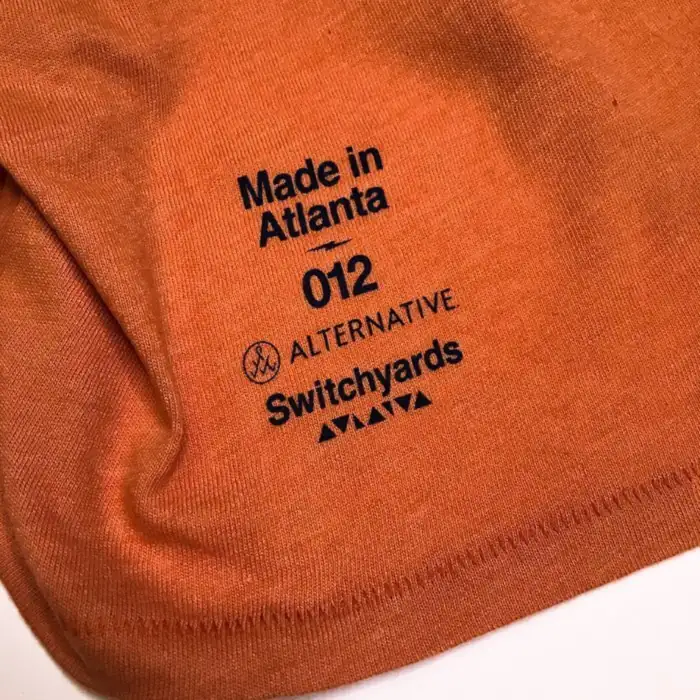
Want to save on cost, but keep brand visibility? Opt for your logo on a sleeve, hem tag, or back of the shirt. One example is South + Wild’s print on the back nape of the shirt. Another is Switchyards Downtown Club and Alternative Apparel’s collaborative design by the front hem.
The best advice we can give is that simple, is in fact, how you should keep it. Put function before decoration.
How Much Does a Printed Tag Cost?
Here’s how we price printed tags:
- Printing: $1 a shirt on orders of 50 or more, and $2.50 a shirt under 50.
- Screens: $10 per size, since each size is its own tag. Small through 2XL is five sizes, so $50.
- Ink color changes: $6 per change, per size, when the tag color changes between shirt colors. One gray that reads on every shirt (tip 4) avoids this.
- Factory tag removal: $0.75 a shirt.
Tags are added to a shirt order, and the tag price is usually folded into your per-shirt price on the quote. Ask for printed tags when you request a quote.
Good to Know
Short answers from our customer FAQ:

Melyssa Micallef
Bread maker, yoga enthusiast, francophile. A small aspiration of mine is to one day lead a group of people in singing and dancing to Shout by The Isley Brothers.